The myth of the mystical Phoenix is that when it dies it turns to ashes, those ashes then ignite into a golden flame of rebirth, and the Phoenix lives on, renewed.
Traveling opens the heart, mind, body, and soul through all of its wanderings. Traveling creates the ashes from which the traveler is reborn, and love lights the fire.

I am a backpacker, a social worker, a grateful receiver, an eternal empathizer, a seed growing, an ear listening, a child learning, a sister sharing, an American evolving, a therapist reflecting, a daughter caring, an embrace holding tightly, a friend to all - I am a Traveling Phoenix, experiencing the world that sets my soul on fire with love. Thanks for joining me.
Showing posts with label family. Show all posts

Monday, June 8, 2015

The Traveling Social Worker

I'm sure that travelers can recognize the sentiment, that maybe after some time, it feels as though you put your life on hold at home. It's not a bad feeling, or a good feeling, simply a parallel feeling that there are two lives being lived, and one can easily be paused while the other continues. You have a travel life and a home life. The world carries on. Your family and friends' lives proceed. Maybe you wonder if you being there ever made a difference. Certainly it did, however the thought can creep up on you. Maybe there is nothing you miss, and this disconnect concerns you, or, better yet, thrills you. Maybe you become jaded from a life away from home, constantly having to reaquaint yourself with surroundings - always introducing yourself, having the same conversation over and over. Maybe all of this causes you to miss home, or maybe the fact that you don't miss home at all makes it feel as though it isn't your home anymore. Time no longer exists, only the day to day - money, and basic necessities. You had an education you might not be using, things you did and were passionate about before that don't matter anymore or that you don't have access to. With new knowledge comes new passions, and new passions can make a whole new persona.

When I originally left on this trip more than ten months ago, I justified my abandon by saying that traveling will enhance my career as a social worker. It will give me insight to all kinds of ways of life - cultures, ethnicities, and beliefs that exist around the world. The mere ability to say a couple of words in someone else's language can strongly enhance rapport when empathizing with clients of all diversities. I said to myself, I will volunteer in other countries to help me get by, and that will support the building of my resume during my extended absence.

After receiving my masters degree in social work, I had a few months to put my affairs in order before deciding to leave for a prolonged period of travel. A period that, in time, became more and more drawn-out. So far I am four months beyond my personally advertised return date. By the time I actually do return, my originally planned trip will have more than doubled in length. Spontaneity is a beautiful gift, considering that concrete travel plans are as real as a "worse case scenario." Everyone can imagine how it will go, but no one sees it come to pass the way they envisioned. Definitive travel plans on extended journies never follow through, and only seem to prevent incredible opportunity. I learned this a long time ago, and for the most part, threw limits, expectations, and deadlines out the window.

As freeing as it has been, lately I have felt as though I put my entire career on hold to travel the world. I can't help but recognize that, at times, my experiences are more for personal gain than they are for educational knowledge that will 'enhance my career.' Since most service opportunities on this side of the world require the volunteer to pay for participation, the idea of building my resume abroad became distant and virtually unrealistic. Sixteen months of "unemployed traveler" may not be the best way to sell myself to the next employer. Certainly not with the argument that such a long absence may have caused me to become out of practice.

All of these thoughts about my absence, and abandon, had been rushing in as a full year of travel rapidly approaches me.

The other day, a symbolic gift was sent my way that would later bring me towards feelings of fulfillment and purpose. I received in an email a post-test survey concerning my graduate degree specialization in integrated primary and behavioral healthcare. As I completed the questionnaire I found that most of the examining questions went as follows: On a level of 1 to 5, rate how confident you are in working with clients of different cultural backgrounds (1 being not confident, and 5 being extremely confident). Topics included; communication using nonverbal behaviors, racial identity, language barriers, educational background and interests, gender role and responsibility, role of elders and children, recognizing your own personal values and beliefs and preventing or resolving their intrusion into practice, comfort when entering a culturally different world, similarities and differences between cultural groups, clients refusal of treatment based on beliefs, need for cultural care preservation/maintenance, cultural sensitivity, dealing with racism and prejudice of clients while maintaining a non-bias practice, religious conflicts, values, etc. etc. etc.

About halfway through I began to laugh out loud at my previous concerns over 'enhancing my career.'

Maybe I am no longer in a therapeutic group setting - teaching mentally ill women how to appropriately cope with feelings of anger while living in a homeless shelter. Maybe I am not doing one-on-one private in-home therapy with hospice clients. Maybe I am no longer doing in-home structural family therapy with troubled youth and their parents in the struggling heart of Brooklyn. What I am doing is communicating on a daily basis with people from around the world, learning about religious and cultural practices, coping with my own discomfort in rural and suburban underdeveloped settings to the point where there is no discomfort, understanding the basis of my values and how they differ from the people around me, learning about wars and racism between ethnicities I didn't even know existed, using different languages, seeing firsthand the daily practices of different cultures, understanding traditions and ways of life, experiencing fundamentally complex and corrupt governmental effects on citizens, living in other peoples' homes, practicing different religions, teaching about love through my own openness, etc. etc. etc.

After taking the post-test, I realized, I haven't left a life on pause somewhere. There is no "home" to go back to or life I left behind. There is no extended "absence." I have never been more present. I am home, everywhere I go. I feel it is a gift to be able to say that even after traveling to 43 different countries in my life, and counting. I can find comfort in anything or anyone, in myself, and at any location. Life before travel, is simply that. It's not continuing on its own - there is still a life being lived. This concept of living a paradoxical double life doesn't exist. People at home will go about their lives, as travelers go about theirs. We will grow in our way, and they will grow in theirs. At the end of the day, I have captured more in a moment than I could possibly have dreamed of in a lifetime. No matter which way we spin it, it is for personal gain - the kind of gain that will make us better practitioners, friends, lovers, and empathizers. The kind of personal gain that benefits everyone wey meet. Every backpacker must be a social worker to an extent. Every traveler must have this knowledge that enhances any career or relationship they have. It requires an openness, a tolerance, a patience, a self-awareness, and an overall understanding of one's personal role in humanity.

I used to think that when I decide to call it quits with long-term travel, or put it on hold until further notice, that is when I will settle down and begin my professional career.

The truth is, I am settled, and I am practicing social work every day. The important thing for all travelers to remember, is what this survey reminded me. Although we may not be working or volunteering, or even interacting with locals every day - we are spreading wealth and knowledge around the world. In return for satisfying the basic human need to participate in humanity, travelers gain an immeasurable growth and goodness that can only effect positive change within and without themselves now and forever. I dare others to be their own genies, grant their own wishes. As travelers do when they choose to travel, I encourage you to also follow your dreams. It only makes us better at being.

Saturday, December 27, 2014

My Nepali Family

Leaving from Istanbul to Kathmandu, and choosing to stay for a month, was one of the boldest moves I have made. I booked my international flights within a week, in and out of Kathmandu, with no plans for the 30 days in between. I intended to volunteer in Kathmandu, living in a homestay and working in a school.

When I arrived at the airport, I was retrieved by my homestay dad, Shanker, and introduced to the basics of Nepali life. The primary introduction consisted of the smallest international airport I’ve been to yet, (smaller than my home town domestic airport in New Hampshire).

Dirt roads. Dust everywhere! The streets in Kathmandu were a basic free for all. In between cars driving on the left side of the road, were motorcycles getting through traffic in whatever way possible. On several occasions during my stay Shanker – or friends I made – took me around the city on their motorcycles. The potholes were so excessive that we would be driving at full force head on towards an oncoming car or motorcycle, not turning until the last minute. The roads of Nepal were most commonly a free for all. Thankfully, the most dangerous roads were at least partway paved.


The Hindi traditions I learned while in Kathmandu consisted of observing my host family’s living and eating habits. My host sister, Chunchun, introduced me to Bollywood MTV and we would create dances for hours on end. She and I goofed around a lot, and had fun being kids. 


The food at the house was always Dahl Bat.

Dahl Bat is a traditional meal, typically eaten twice daily (more or less). It consists of rice, a small portion of vegetables, and a vegetable or chicken liquid to pour on the rice. The common phrase, is Dahl Bat 24 hour power! You can eat it any time, anywhere.
Before eating, the family would each take a small amount of rice (a fingernail size) and place it on the table next to their meal before beginning to utterly engulf their food with their right hand. I followed suit with the new traditions, learning that the rice set aside was a sacrifice to the Gods, and holding my hand a certain way so as to push the food into my mouth with my thumb was a more efficient way to eat.

I didn’t learn until a week later, that even Nepalese don’t always eat with their hands, and it wasn’t really necessary for me to do so. Nonetheless, I preferred it. It gave me purpose to play with my food.

Shanker Man insisted on taking me to several different locations in Kathmandu at his own behest. When I went to the temples, I rang the bell in front of the Hindi statues, placed flowers on my head, and filled myself with the positive energy from the gods. Some of my favorite gods are the dancing Shiva (the destroyer), Surya Ganesh (incarnate of Vishnu the preserver), and Brahma (of course, the creator). The first Temple I've ever been to was Monkey Temple, and the reason they call it Monkey Temple, is because on the grounds of the temples are thousands of... monkeys. Thousands. I fed them with crackers that we bought at the market, and some crawled onto my leg. They weren't the nicest monkeys though, fighting each other and screaming a sound that made me think they might attack me.


Unfortunately, I did not receive any details about the volunteer work that I was meant to do in Kathmandu, other then where the school was located. Once I arrived, I learned that the children were very young, and having worked in several different parts of the world with children, I wasn’t comfortable becoming attached with them if I only planned to stay a few days. It’s not healthy for children to make attachments and for those people to always leave them. Not to mention, there was no volunteer work needed at the location.

On a daily basis, I began to walk or ride the motorbike with Shanker to his money exchange office in the main tourist hub of Kathmandu, called Thamel. One of his new employees, Rabin, became a good friend of mine and introduced me to the relaxed nightlife of the locals. Each night I walked with Rabin twenty minutes to where his friend owns a shop. Although, I’m sure his friend owns a “secret hangout disguised as a shop” since we had to walk through dark allies behind buildings and needed a flashlight just to find the place. There were rugs in the room that were meant for selling… but they were the same rugs every day. I asked Ring, Rabin’s friend and my new friend, when the last time he sold a rug was. There was no coherent response. I became friends with all of the regulars who came to Ring’s shop in the evening to drink homemade whiskey and play cards. The oldest man in the group, Barbar, who I called Baba (father), drove me home at the end of the evening before he went home to his wife. I was thankful for that since the dirt roads were deserted after 9pm. Rabin and I even stumbled across his friend Kim on the first night that I went to Ring’s shop. Kim is an American who has been living in Nepal working for a Non-Governmental Organization and studying Nepali. She is so sweet and full of life that she insisted on meeting me. We became instant friends, just like everyone else that Rabin introduced me to. By the time I left Kathmandu, I felt like I had created a family.
Ring, Baba, Soogar, and Rajis, are among these amazing guys!

If I hadn’t stayed at the homestay - with Shanker, Chunchun, her mom Padma, and grandma who I called “Ma” - then I might not have had some of the amazing opportunities that I had. One of the family members who came over for a visit one day, spoke English very well and was fascinated with my travels and my work as a social worker. It turns out, that he (Mygendra) is the #1 exporter of wool in Nepal, and had been looking for a social worker to communicate and empathize with the men and women who work in his factory. Many Nepalese women live difficult lives, and having someone to counsel them and hear their stories is very important. The next day, he was gracious to bring me to his factory 18km outside of Kathmandu to a town called Baktapur. There, he gave me a tour, introduced me to many of his employees including an American distributor named Matt, and conducted several business meetings with me about ethics and interpersonal relationships in business. In between working with Matt and Mygendra, and touring the factory, I had a few hours to kill before we all drove back into Kathmandu. As if Mygendra wasn’t already showing immense hospitality, he had his factory chauffeur take me on a motorbike into the center of Baktapur to see the temples, and try some of the traditional local foods. Baktapur is famous for being home to the milk curd. I went to eat at the Curd King, where I learned that milk curd tastes like ice cream and most locals don’t like it because many don’t like cold foods. I understand, because cold means that it isn’t necessarily hygienic, so they don’t eat cold food often. I wished that I could take a bucket of the stuff from the Curd King and bring it back to America, but dairy doesn’t work like that.

The people of Nepal were extremely loving and warm to me. However, I couldn’t stay in Kathmandu for one month. The pollution of dust from the unpaved roads, and sidewalk-less streets were enough to make me feel like I was nursing a cold the entire time that I was staying there. I took medicine every day, and eventually my allergic reactions really did turn into a cold.

Something people in Western civilization don’t seem to think about often, is how lucky we are to not deal with the pollution that is all over Asia. It’s hard to breathe some days. My nose might burn, or my eyes might not be able to open on days when the pollution is bad. I will never take advantage of fresh air, ever again. The reason I didn’t leave Kathmandu sooner, was because my passport was being held at the Chinese Embassy for my visa, and on the day when I went to retrieve it, I didn’t have U.S. Dollars to pay the visa fee. I learned the hard way, that because I am a U.S. Citizens I can only pay for my visa fees in USD all over Asia. It took me two days to find an exchange place that would give me USD, and then another day to book my bus out of Kathmandu. The trick was to figure out where I should go.

On the plane ride in from Turkey, I met a 70-something year old woman who was traveling with her son to go climb Mount Everest. She told me, that if I have time to travel around Nepal, I should go to Chitwan National Park. So, without much of a plan, I booked a lodge and left the next morning on a 6 hour bus ride - through mountains on winding roads - to the south of Nepal. Into the jungle, if you will. I was happy to have some time outside of the city, with fresh air, to recover from whatever I had caught.

Leaving Kathmandu and entering into the unknown, was the biggest adventure I had in Nepal. Every day was brand new, unplanned, and uninformed. The first day I rested. In Sauraha, bordering the wild jungle of Chitwan National Park, there were no streetlights, and the fence across the street that separates the world from the wild jungle was less than intact. It was not safe to walk around at night after 7pm. My first day at the lodge was spent reading and eating Momo (Tibetan & Nepali style dumplings).

I wasn’t alone for long. One night I found friendship with a 6 year-old boy, who loved dancing. It didn’t take me long to get the lodge bar to turn up the music, and dance for hours with this little guy, whose name was close to sounding like CVS. Between watching Bollywood in Kathmandu, dancing with my homestay sister Chunchun, and dancing with CVS, I had pretty much nailed some of the classic twisting and pumping moves that are popular in the country. Before you know it, CVS and I were tying scarves around our heads and shaking our tails off. It was a perfect release, since earlier that day I had spent 5 hours riding a rented bicycle across unpaved jagged roads through the community jungle. My butt was killing me. I didn’t want to lie down and sleep at 7pm, but I didn’t want to sit around either. A good shake-off and dance competition was just the ticket. Just before my dance-off competition - after my rigorous bicycle journey, with the jagged roads, and mental struggle - I said a prayer asking God for me to only encounter goodness and perfect conditions to uplift me. Prayers answered? Check.

That’s how I met my friend Anna. In the course of my dance competition with CVS, I noticed that a red haired smiling girl was watching us and laughing. Of course I looked silly, but I always thought silliness made me more extraordinary, not less. When it was finally time to take a break, I sat down for dinner and invited Anna to join me. Immediately I connected with this girl. I still don't know her life history, her family, native language of Swedish, or even what her favorite anything is, but she has a light about her that speaks far more than words – a light that only people who are deeply routed in goodness can have. It only took another full day of trekking in the jungle together for me to learn that I could trust her, and that meeting her was quite literally an immediate answer to my prayers.

The jungle trek was a life-risking adventure! I participated in a half-day trek before, however, I didn’t get to see any animals. I fell in love with the excitement of searching for them in the jungle with our guide.
The day after meeting Anna I had, literally, the perfect day full of goodness. I was refusing to pay the extra $17 that the lodge was aiming to charge me for another jungle walk – particularly since every time I entered the office to inquire about the cost, someone gave me a different price. It was easy to know that they were inventing an exploitative commission. The jungle guide overheard that I wanted to go, but did not want to pay such a ridiculous commission. $17 in Nepal is equal to 1,700 rupees, which is equal to 3 or 4 nice meals. The guide found me, snuck me aside, and told me I could pay the park directly, and his fee directly, and save the extra money. This is how my perfect day started. God's plan in motion! So I grabbed my snacks and my water, and headed into the jungle with Anna and a couple - Marlaine and Stephan. I always know when I’m in good company, because I just feel it. When I feel that I am in good company I am also usually curious to learn what everyone does for a living. I wasn’t surprised to learn that I was spending the day with two psychologists and a social worker. Knowing that someone works in a profession grounded in empathy and love, can speak volumes to their personality.
Left to Right: Stephan, me, Marlaine, & Anna
Our journey into the jungle began riding in a hollowed tree canoe up the Rapti River until we arrived deep into the edge of the Sauraha side of the Chitwan jungle.

Along our ride we saw over 15 different alligators and 10 different kinds of birds. We heard from canoe drivers, walking their boats up river, that we were approaching a rhinoceros. When we approached the feasting fiend, we pulled the canoe over to the side of an eroded cliff and hand climbed up a wall of vines and mud, so that we were within a few feet of the rhino! We whispered and took safety precautions, (like remembering to huddle together or locate the nearest climbable tree) as we followed the rhino up the path in his giant wake. The most exciting part was walking across naturally made log bridges, careful not to fall into a sinking pit of mud, and hand climbing up the wall and back down afterwards.

Once we continued on our journey we arrived in the jungle, laughing and joking all along the way. It wasn’t until after our lunch break that our trek guide told us, whatever we have to say, to get it out of the way and shhh from here on out. We were searching for a tiger after all. He gave us all of the safety tips. If a rhino or tiger approaches, climb a tree. If a bear approaches, huddle together and grab a weapon, or run like hell as your final option for any life threatening situation. Our guide was amazing, he stopped to smell poop just to tell us how long ago the animal was there. I always made sure to stay close behind him.


After a 4 hour hike through the jungle, silent laughter, and seeing a number of different wild animals, we all headed back, showered up and then joined another couple for dinner and card games. Coincidentally it was on thanksgiving, and with the new bonds I made, I was so thankful to be with amazing loving company and great food!

The manager of the restaurant is someone I will never forget. His name was Osac, and he was entertaining to talk to because of his choice English phrases - said with his stronh Nepali/Hindi/Indian accent - were some of the highlights of the evening. For example, every time he approached our table (between long intervals, sometimes hours) he would say “ahh yes, excuse me yes. Is okay?” Meanwhile, we haven’t been served anything. “yes, is okay” was his most common phrase. On one occasion we had been waiting a half hour after ordering some classic foods, like Momo and Dahl Bat, before Osac came over and said, “excuse me, excuse me. Yes, the food is not coming.” Why? "Your food is coming, but your food is not coming. We have no Momo." It was odd that he would say that they don’t have Momo. It was on the menu, and is a simple and classic Nepali dish. Not to mention that we had ordered quite some time ago. Osac paused a little bit as if to chew on his words a little bit, mumbling, and then pointed to the man at the table next to us while he said, “Well, there is no Momo… because the chef is very drunk.” (You mean, that guy over there who has been harassing us and coming to sit at our table?) We all sat for one second before making eye contact with each other and bursted out in laughter. I asked between fits of amusement, ‘So who is making our food? Do you need help?’ And he said, “is okay, he make only the Momo. We have no Momo because he is very drunk.” We laughed hysterically at the language, and the circumstances. Osac didn’t sugar coat it at all, and the Momo chef was very very drunk. Drunkenness and alcohol are looked down on quite a bit in Hindu and Muslim countries, so all of the factors were surprising and hillarious. 

The honesty of Nepali people is brilliant.

Needless to say, we did not have Momo, but the food was still good.
We polished the night off teaching each other card games we knew from our varying home countries.


My goals around Nepal, aside from trekking in the jungle, were also to travel north in order to go trekking in the Himalayas. Without a partner, or a guide I couldn’t afford, it seemed impossible, so again I took my needs to God, and told Him that if I am meant to go trekking, then the perfect conditions would arise.

The next day I made the decision to travel to a place called Lumbini, across the top of Chitwan National Park to the Western border between India and Nepal. It turned out, that in order for Anna to take a bus to India, she also had to go to Lumbini – so we decided to go together.

Lumbini is a large sector marked as a UNESCO World Heritage Site. It is 3 miles by 1 mile and is best known for its temples and for being the birthplace of Siddhartha Gautama (the Buddha) in 623 BC.  

The exact birthplace of Buddha in 623 BC. Govered in plexiglass and different foreign currencies, but underneathe is a good ol' slab of granite.


Anna and I spent only 3 hours on the gardened land where dozens of temples are represented from around the world. When I entered the Maya Devi temple where the original ruins from Buddha’s birthplace are kept safe inside of a plexiglass entrapment, I saw before me ancient ruins from before Christ. The walkway follows along the walls of the temple, while the ruins stand in the center, and a ramp leads out so that people can go closer to the exact birthplace. Lying on the ruins were currencies from all over the world to be collected for donation to the temple. As I entered to the left circling around the ruins, a group of Buddhist monks from China entered in a single file line. Slowly they took steps in a single file line, one step at a time, allowing their feet to kiss the ground – and chanting in their native tongue. I joined in the line. I don’t know what they were saying, but the use of tones is what’s soothing, not necessarily the words of the chant. I circled around, and afterward felt refreshed and renewed, as if my head had cleared.

After our walkabout, Anna and I returned to our hostel room. The hostel was probably the poorest conditions I’ve stayed in. We were the only guests in the facility, and aside from the bugs spattered on the wall, and no net hanging over the bed – I didn’t have any complaints. I can stay anywhere as long as I feel safe. So I asked for nets (to protect from bugs carrying diseases), and what the hostel owner gave us were essentially, moth nets the shape of tablecloths and tied up over our bed in various positions around the room. I felt satisfied after that, and it was quite a sight to see!

The conditions of Lumbini were the poorest developed that I had seen in all of Nepal. I brought toilet paper and germX with me everywhere in the country, since although the Turkish toilets were always available; there was never toilet paper or paper of any kind and often no water. There was definitely no hot water.

From Lumbini I planned to go to Pokhara, Nepal, where I would go trekking for 4 days at the start of the Annapurna Circuit in the Himalayas – provided that my perfect conditions arose. Anna had finished climbing Mount Everest not too long before we met and was interested in trekking in the Annapurna region despite her previous plans for India. So when I said before that God answered my prayers to give me the perfect circumstances, Anna was very much an answer to my prayers, not once, but twice! Rather than go our separate ways from Lumbini, she traveled with me another 8 hours to Pokhara Nepal where we stayed for a few days in between trekking.

After a grueling twisting and turning ride through the mountains, Anna and I arrived at a hostel just before my motion sickness started to kick in. Pokhara was a whole new world compared to Kathmandu, Chitwan or Lumbini. There were paved roads, thick sidewalks, and many modern westernized restaurants and shop stalls. My favorite part about the restaurants was the free popcorn they served. The city overall was more organized, better suited for tourism, and welcoming. It would be easy to go out for a night on the town in Pokhara.
 
The view from our hostel in Pokhara, Nepal
We stayed in a hostel for two nights before leaving early in the morning to begin our trek. I rented a backpack so that I wouldn’t have to carry all of my things, and I purchased lots of under armor. We were heading above the clouds and it was not tropical weather in Nepal! Trekking at this time of year surrounded us with snow and cold after a certain altitude. On our first night in Pokhara we returned from an adventurous encounter with some locals, followed by an evening dinner. Later, a girl staying up the hall from us in the hostel approached us. She was from California and traveling alone wishing to go on a trek. I was hesitant at first, as I sometimes am with new people I meet, but as it turned out, Azin (was her name) was a lovely young woman who introduced us to her Australian friend. By the end of our second night in Pokhara, we had created a small trekking group; me, Azin, Anna, and Rob. Rob was heading out to go to Annapurna I - which is the Annapurna Base Camp - and the rest of us were aiming to do the first three days of the trek before heading back on the fourth day. Rob had a guide (named Delhi), and was interesting to talk to because of his deep affection for animals and his experience trekking. I was grateful to have happened to be traveling with someone who paid for a guide also because there may have been a couple of parts on the trail where I wasn’t sure which way to turn. Delhi was nice enough to always tell me how much further we had to go too.

If those aren’t the perfect conditions, then I don’t know what are!

Our 5-person group ventured out and for the first two days we climbed steps up the mountain to 3,200m (10,498 ft). It was consistently steps all the way to the peak called Poon Hill. The steps were often piles of rocks or branches, and the inconsistency of them made it a challenge. Staying at teahouses at night was also a new experience. The beauty of trekking in Nepal is that all along the route are villages, and in those villages are guesthouses that cost between $1-5 a night. After a certain altitude the guesthouses no longer offered hot water or electricity, but all along the way we encountered the same menu for food and ate the same delicious local treats. I ate lots and lots of chocolate. In the evening after trekking we would shower (or not), relax, kick up our feet, and play cards over tea and dinner.

On the second day, rather than get up at sunrise to go to the top of Poon Hill, I wanted to go and watch the sun set. I was tired. The stairs were astonishingly challenging on the second day. There was no way I wanted to wake up in the freezing cold before the sun came up in order to go to the top of the mountain for the start of a 7-hour trekking day. So instead, my entire group went along with my idea and joined me up to the top of Poon Hill that evening to watch the sun set. Our day was a 6-hour trekking day, and it was perfectly worth it. In the wind I stood for 20 minutes watching the distant mountains of Annapurna and Machupuchre turn dark blue, and then pink and purple until finally the sun was set. Afterwards we hiked back down the steps for an hour before snuggling up near the heater in the guesthouse and playing a fun game of Uno with other trekkers. The trekking life is a work hard play hard life!


Left to Right: Me, Anna, Rob, & Azin

The third day of trekking was the best day, in my opinion. We weren’t going up stairs the whole time, but we also weren’t going down stairs the whole time. The views were spectacular as we weaved through the jungle terrain passing waterfalls and crossing bridges.

After saying our goodbyes to Rob as he continued on his trek, Azin, Anna, and I headed down the mountain and eventually back to Pokhara. While Anna rested to recover from a sickness, Azin and I had our celebratory farewell dinner together (complete with popcorn. Two nights later I was on my own once again. It was sad to be on my own after splitting from Anna and our new friends. I felt like I had met my soul sister by how connected we were so quickly. It was such a blessing to meet al of them.

After trekking, I decided to stay in Pokhara for a week, doing nothing and enjoying my down time. I shopped for Christmas presents for my godsister who I would stay with in China for the holidays. I ate delicious food, read my books, and rested up for the days to come. For only three days in the week I explored parts of Pokhara beyond walking along the Lakeside and main roads.


I rented a motorcycle to ride to the top of a mountain where a well-known village called Sarangkot is home to a popular paragliding launch site. It was exciting for me to ride a motorcycle on the left side of the road, let alone on the edge of cliffs, along the side of a mountain, high in the sky. For a long time I had been afraid of heights, and afraid of speed (or loss of control), so conquering my fears and allowing myself to be lost, spontaneous, and virtually out of control, was a freeing feeling. I stopped along my route to take pictures and watch the paragliders take off.


One of my last days in Pokhara was spent taking a canoe boat to a hill where at the top sits the World Peace Pagoda. There are many peace pagodas in the world but this is the only World Peace Pagoda. From the canoe I hiked for one hour on slippery mud paths up to the Pagoda, read all of the plaques and paid homage to the symbols at the top and the amazing view of the Annapurna Conservation. It seems every mountain I climbed there was an amazing view of the Annapurna Conservation. As they sing in the Sound of Music, climb every mountain, ford every stream, follow every rainbow, 'till you find your dream.

After taking photos I headed back down the mountain to find a French and German man, lost at the beginning of the trekking path. They needing to locate a canoe to return to Lakeside, Pokhara - and I already had my canoe waiting for me. We hiked for an hour or so, chatting and laughing. After getting dinner at the lake we headed back for a stroll along the main street before parting our separate ways.

The next day I traveled back to Kathmandu so that I could have a few days to say goodbye to everyone before flying to China. It was a long day of travel, the true Asian way. After only an hour of driving, our bus hit a motorcyclist. I knew when I got onto the bus that this would happen – I just knew it. The reason I knew is because for two consecutive days prior I had seen motorcycle accidents. As Paulo Coehlo says in the Alchemist if something happens once it probably won’t happen again, but if something happens twice it will definitely happen again. So it was no surprise when my bus was delayed at an accident site and later at the police station for about 3 hours.

The other ironic side-note that was thrown in for good measure – the name of the bus company was “Open Heart.”

When I arrived in Kathmandu it was raining, and dirt everywhere means mud.
I walked in the mud and the rain looking for a hostel that I didn’t book or locate. I entered three or four hostels before I found one that was affordable, clean, and in a fantastic location. I kicked off my shoes, went to dinner, and messaged all of my Kathmandu friends to let them know I was back in town. The next night, all of the people I became friends with for the first few weeks in Nepal, invited me to do the same old, drinks and cards, and an enjoyable late night. Much to my pleasure and surprise, it turned into what felt like a going away party. We took pictures, and Kim even gave me presents! When I left the next day, I felt like I was leaving my family.
Me in my Nepal hat that Kim gave me as a going away gift, and the one and only Ring!


The people in Nepal were all so relatable and warm to me. All of my experiences were good and personable. I became friends with every shop owner. I became friends with every other person with my spontaneity and openness. The nature of Nepal is beautiful in and of itself, and although Nepali business people have a willingness to exploit tourists because they are in need of money, I have complete understanding, compassion and love for them all. It was a perfect month, and so far, it was the longest that I’ve been in one country since I began traveling. I wouldn’t have it any other way.

To top it all off... I saw Mount Everest on the flight out.


Friday, October 24, 2014

Moroccan Love

My first night in Morocco I rejoiced in the splendor of having both my parents all to myself. My mom and I arrived from Italy and met my dad at our hotel in Casablanca for the night. All night we talked and showered each other with love. That day and the days to follow we also spent our time becoming aquainted with the man who would drive us through over 10 different cities and villages throughout Morocco, his name was Mr. Hussine. He was a man who truly served us and loved us in every way, and in doing so he added air to my fire of faith.

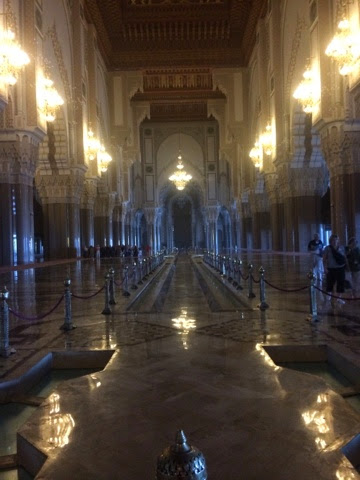
We only had a short time, but before leaving Casablanca we toured the third largest mosque in the world. The Mosque of Mohammed Houssine II.
It is the largest mosque outside of the Holy Land of Mecca in Saudi Arabia. Surprisingly the mosque took only 6 years to build its total of 13 hectors of marble floors, cedar carved ceilings, and chandeliers made out of Italian Murano glass.
 Being in a Muslim country, I had the opportunity to learn more about Muslim traditions. In Morocco the religious demographics look something like; 80% Sunni and 15% Shi'a - the other 5% being Jews and Christians. Shi'a Muslims were described to me as the more "hardcore" Muslims, like Orthodox Jews, or more strict Christians. Sunni Muslims were described to me as "everyone else." The guide who told me about Sunni and Shi'a may have been a little bias since he himself is Sunni. He described Moroccan Shi'a as the "extremist" Muslims - at least as far as Moroccan culture, and his opinion goes.

Some of the traditions I learned about had to do with daily devotions to God. For example, each limb and head must be washed three times as purification before prayer, and, in case you didn't know, prayer is 5 times a day: at sunrise, lunchtime, late afternoon, sunset, and dinnertime. Muslims, at least the ones who participate in prayer, must be pretty darn clean people if they are washing that often. There are a baths for purification in every mosque I've seen, in case people come from work or school. During prayer, women kneel in in the back behind the men in the mosque. Reason being, everyone is kneeling bent over in prayer, and a bunch of women's butts in the air can be a major distraction for the people behind them. I can understand that. I also like the tradition of covering up in order to keep the body sacred, so that some day only the husband will see what is underneathe. That might even be better than being a virgin till marriage. It makes everything so much more sacred.

After the tour of the mosque, we drove from Casablanca to Rabat where we had the rare pleasure of entering the Royal Palace and admiring the Moroccan mosaics and Moorish architecture. We went to a beautiful building covered in mosaic designs, cedar carved ceilings, and marble floors. It was a mausoleum that contains the tombs of the great Mohammed V and Mohammed Houssine II - former kings of Morocco and saviors of Moroccan culture. All of the streets are named after them, so asking directions isnt so helpful. 

 All the Mohammeds can be confusing too, though its considered a strong and honorable name to have. In order to honor the Prophet Mohammed, many Muslim families follow the tradition of naming their firstborn daughter Fatima, and their firstborn son Mohammed - after the firstborn children of Mohammed the Prophet. If ever I forgot someone's name while in Morocco, Mohammed was a pretty good guess.

Being from an Arabic Christian family, despite my studies, I am not as well read with living in Muslim tradition, and not even Arabic traditions since my family is strictly Lebanese and Syrian American. We do our best to carry on traditions and teachings from the previous generations, but things are so vastly different from country to country in the Middle East. Our language, Levantine Arabic, differs compared to Egyptian, Moroccan, or Saudi Arabic. Nonetheless, we enjoyed saying our "family phrases" among other Arabs who understood what we were saying. A few of my favorites growing up, were the most commonly heard among the Moroccans too. I can't write in Arabic, but phonetically, inshallah (in-sha-luh), meaning "God willing" or allah a'akbar (ull-ah ah-ahk-bahr), meaning "Glory to God." My Arabic accent is noticeably Levantine. Many times when I spoke, the Moroccans would ask me if I am Syrian or Lebanese. When shop keepers would haggle me on the streets, the conversation normally involved confusing them by speaking Arabic and saying 'no' to everything they asked me, or telling them where I'm from in order to get a better price. 
Shop Keeper: hello miss, you come into my shop!
I say nothing.
Shop Keeper: English? English?
I say: 'la'a (luh-uh)' meaning 'no' in Arabic with my Syrian accent.
Shop Keeper asks me in Arabic if I speak Arabic.
I say: 'shwaya', which means "a little"
And then while he continues to guess where I'm from, I keep saying no in Arabic while I walk away and eventually he stops chasing me.

Life is a chase ladies, let me tell ya. Whenever I was interested in whatever the person was selling, I became the chaser. I always made sure to tell the salesperson in Arabic that I am Syrian and Lebanese. Then he says in English "I give you good price" or "friend price", "global price", "Berber price" - and all the other ways of saying the "lowest, cheapest, price." Then the hustle begins - the bargaining hustle.

At most shops we spent a half hour shopping, then bargaining another half hour. Thats when, understanding the unwritten rules of bargaining is important. Like, making the lowest offer, but not an insulting offer, not wasting anyones time by playing too many games, knowing what the item is worth - what it might have cost to be made - and how much one is willing to spend. I think I figured out the tells the sellers make when they respond to the buyers first price. Here is my theory based on experience; when the salsemen snears, it means the buyer went too low and insulted him. When he laughs and pretends hes laughing because its too low of an offer, its actually an on-the-money-offer and the laughing is part of the hustle to raise the buyers price. If the seller says nothing, it means the buyer is spot on and the seller is taking her seriously. And, if the seller makes a nervous laugh, then he's actually bummed out because he may not profit from the price the buyer offered. Thats when I think its time for the buyer to consider whether she still wants it, and whether the seller needs the money more than she needs to have the thrill of bargaining and saving money. Normally the other big rule is for the buyer to never waste anyone's time if she isn't truly interested.
Once my parents and I had that down, we were ready for Fez and Marrakech. Markets galore. Shopping heaven! 

Before arriving in Fez on our drive from Casablanca to Rabat to Fez, we went to a local hub of tents where we ate a Moroccan barbecue lunch. We ordered lamb by the kilo, had chicken tagine, and ate beef kefta kebab. Everything tasted full of flavors of cumin, saffron, paprika, and other rich local spices. We drank traditional Moroccan mint tea and basked in the local Moroccan atmosphere. We ate with our hands and observed the grills and cooking styles. It was fantastic. 

While in Fez, we were told by our driver, Mr. Hussine, and by online tripadvisor reviews, that walking in the Fez medina at night was not advised without a guide - for safety reasons. We kept it simple by going to a belly dancing show which we quickly discovered was very touristic and extremely overpriced. We left early. After taking suggestions from Mr. Hussine, and the hotel concierge, we decided from then on to do things that were more our speed, less touristic and less expensive. After all, my dad speaks Arabic, and we are all fairly well traveled and smart Arabs, theres no need for us to be looked after.

The following day we took a walking tour of the Medina. The Medina of Fez is the old town of the city and is separated by walls. Fez is one of Morocco's four imperial cities, alongside Rabat, Casablanca, and Marrakech. Each of the imperial cities has an old town, like the medina, and a new town. The difference between the two is as dramatic as first world versus second world lifestyles. In the new town there are Mcdonalds, chain hotels, nice restaurants, and paved roads with street lights. In the medina - which is enclosed within the greater city area - there are no cars, only occasional motorbikes, and many mules carrying things to and fro. Its as easy to walk into an ally where a blacksmith is firing away as it would be to get a taxi in new town. The medinas are all a little bit different, and in the case of Rabat and Casablanca, they were rather dirty and small compared to the glorious and exciting medinas of Fez and Marrakech.

In the Fez medina the carts are pushed down the streets carrying lamb skins, and goods to sell, and the pusher yells "Ballak ballak," for people to get out of their way. We walked past carts of lambs skin being taken to the tannery to be made for leather, we peaked in bakeries where bread is made in fire ovens, and we saw into factories where weavers create the classic Berber, and Moroccan rugs by hand. During our tour - aside from seeing the oldest university in the world and beautiful Moroccan archetectures - we basically went shopping. A dream come true for the Adam Family!! Because the shopping was part of the tour, we were presented many unique creations of rugs and leathers and the styles were all explained to us.

At the rug factory we looked at hand-made rugs from the Berbers from antiquity, and from Moroccan weavers. There are native tribes in all of the Middle Eastern countries in Africa - Morocco, Libya, Algeria, Tangier, and Egypt - and most of them are referred to as "Berber." Moroccan Berbers are Moroccan, but they are classified differently - not less than - just regarded as having a different culture and traditions than a Moroccan who is not Berber. They are regarded as simple people who have less, do lots of hard manuel labor, and are more of the live-off-the-land people. Driving through the mountains, one could distinguish a Berber home from another's home because of the made-from-scratch look of the straw and clay walls, versus the smooth architectural designs of other homes.

When my family and I were bargaining with people, we started being called 'Berber cousin' or 'Berber from the High Atlas' meaning that we do a lot of bargaining. The high Atlas is comparable to the top of the Alps, so I imagine those people don't get out too often and don't make too much money - so, they must be super bargainers.

My dad, being the fantastic bargainer that he is, was able to get me a free Moroccan rug to take home for the house I'll some day have. Talk about a gift from God! Way to go dad! The owner, Moustafa, shook our hands and told my dad that he is a Berber from the High Atlas - meaning, he is a hard man to bargain with. At the rug shop we drank mint tea, and a couple different men showed me pictures of their daughters named Yasmín. Everyone kept telling me I have a Moroccan name, the name of a princess. And so they treated me like a princess, and I was very grateful. Moustafa told us, some people come into his shop and spend $60,000, and he shakes there hands and says "goodbye." On the other hand, some people come into his shop and only spend $500, and they hug and kiss and have long cheerful goodbyes. We recieved the latter, and it was so warm and sweet - perfect example of Moroccan love, which we experienced continually throughout our trip. 

Since our tour of Fez was on a Friday, which is a holy day for Muslims - like the Sabbath for Jews or Christians - I felt bad to be keeping our guide Mohammed from his prayer time. When I asked him about it he explained to me that there are 3 kinds of prayer; theres prayer 5 times a day, but work is also prayer, and so is spending time with family. I felt like his prayer assistant after that, since he was working for my family that day. 
Mohammed was a fantastically bubbly warm man, full of life with wrinkles from smiling. He loved telling us about Islam, and laughed watching us shop and bargain in the stores. He also explained to us the safety of Fez, saying that we could stay on the main roads of the Medina at night and be just fine! So we went out that night and ate tajine at a local spot. Tajine is like the Moroccan version of a crock pot. Throw in some seasoning, meat, and veggies, then leave it on the grill all day at a low temperature. The cost difference between a local meal and a tourist meal (even though the food is the same) was as much as $100. A local meal for three of us was only $22, rather than $30 a plate at the tourist spots. Talk about exploitation.

The next day began a long adventure. Our plan was to drive 8.5 hours to Merzouga, on the border of the Sahara desert. From there we would ride camels 1.5 hours and camp in the desert for the night, the way the tribes and nomads do. We drove through the Atlas Mountains on winding roads, through valleys where rivers are in the winter from the melted snow of the mountains. Sometimes, on long car rides and winding roads, I become car sick, so I sat in the front seat. We stopped in small villages like Midelt and Rissani along the way for food and bathroom breaks, which gave us a great opportunity to see different lifestyles and meet people all over Morocco. A couple hours after lunch and driving through winding mountains, I felt worse than carsick had ever made me feel, and I asked Mr Hussine to pull over just as I opened the door to vomit. 

Here comes the adventure, as if this was not an adventure already.

Mr. Hussine pulled our car to the nearest city, called Rashidia so that he could find me anti-nausea medication at a pharmacy. Usually, once I get out of the car and sit for a little while, the sickness goes away. Not this time. I threw up on a palm tree in the road, on the sidewalk, and in between I had to make some bathroom trips to the nearest Turkish toilet (hole in the ground) which was utter torture in my condition, I'm sure you can imagine. Next to the hole in the ground was a spout and bucket to wash it off after whatever mess the user makes.

My mom tried walking me to a nearby hotel. I became sick again on the way and when I looked up gasping, I saw a little man trotting over with some water to pour on my hands. At this point I was staggering in the streets, nearly faint, in what is practically the desert, trying to find a bathroom. We found a hotel and went upstairs, and to my dismay no one worked there and a couple who didn't speak English was sitting in the lobby. It looked like a hotel from a horror film. I said to the couple sitting down, 'please, emergency', and made some motions like I will be sick. When she started to get out of her chair I said in Arabic "yella yella" which means go or hurry up. So this stranger must have seen our faces and understood because she opened the door to her hotel room door and let me use her bathroom. It was just as horrifying inside as outside, and the toilet seat was broken clear off the hinges. What a sweet girl to let a complete sick stranger, who she couldnt communicate with, to use her bathroom. Mom looked so panicked, and it really was sudden, and peculiar, so there was urgency in both of our faces.

My worst nightmare while sick, is now a Turkish toilet.
Dunn dunn dunnn

After I made it back to the cafe where my dad was drinking tea, Mr Hussine had returned from urgently visiting every pharmacy in town to find me something useful. After several pharmacies he found one that was open and showed up with syrup to soothe my stomach. 
Thats when I told them it wasn't car sickness and they needed to take me to a hospital right away.

Glory to God, we were in a town that had its own small hospital. Mr. Hussine drove us while I stuck my head out the window continuing my new ritual. I got really funny mortified looks from people passing in cars and motorcycles, but all I could think about was my butt in Mr Hussine's face while I put half my body out the side of the car.

I went into the hospital and they sat me down. Everyone spoke French and Arabic but no English. Hell no was I sitting down in a waiting room, not unless they wanted a scene. I was in misery. I got a little bossy at this point. 'Tell them I need a bed and a toilet right away,' I said to Mr Hussine. So they took me to a room and laid me down on a brown plastic bed. I was moaning and after another episode of sickness I foggily looked over to see a man in plain clothes holding my right hand. I said thank you. Who is this? Is this the doctor? All of the interns were dressed in street clothes with an opened white doctors coat on top, so I had no idea what the doctor would look like. Would she be wearing Adidas or Nike? My parents told me the man holding my hand trying to soothe me was just the guy whose mom was in the bed next to mine. He felt bad for me because I was so miserable, so he held my hand. I started balling like a baby thanking him and praying in Arabic. It really was so touching that so many strangers were trying to take care of me in little ways. I felt so grateful.

One of the interns stuck me with an IV and some medicine, which was probably the most painful and bloody IV ever. At this point I was crying and breathing so heavily that I was making noises in pain. After a few seconds my pain noises and deep breathing turned into gasps of laughter. I suddenly felt like God was tickling me and everything that was happening - between the Adidas doctor, using a strangers bathroom, and all of the looks I got vomitting all over the town of Rashidia - I started laughing uncontrollably. The intern (who is taking all this time to still put the IV in me) began to laugh at my insanity too. Then my mom joined in with her loud laugh, and eventually my dad started to chuckle at how ridiculous it all was. The intern finished with the IV and gave me a thumbs up, I burst out laughing with tears streaming down my face, and gave him a thumbs up right back. In between laughing there was a lot of crying and praying, until finally I had released so much energy that I began to doze in and out of sleep.
 Its always best when energy is released through laughter.


So then I laid there in between episodes of sickness, nearly falling asleep on a few occasions until my dad rubbed my forehead or my mom whispered to him really loudly. Or my parents took goofy pictures around me! Hah! It was so perfect to have my parents with me for this. I was taken care of. No taxi to the hospital, no conerns for how I would get anywhere or get medicine I needed. My mom, dad, and Mr Hussine were doing all they could. Even breaking into the doctors room to clean out my bucket of vomit. Mr. Hussine really went above and beyond for me, and we created a strong heartfelt connection from there on out.

I had countless experiences of people taking care of me, holding my hand or giving me water. Everyone I came across was so warm and perfect. God's will is perfect in every way, always looking after me.

After the IV treatment, and the medicines, the whole Moroccan Flu ordeal cost 40Durham - $5.

Mr. Hussine was an angel, by getting me whatever I needed and saying I'm like his daughter. He took care of everything from my vomit, to my medicine, to having the car windows down, and my pillow fluffed.

Even though I was still pretty sick, eventually we were able to drive an hour more to a city called Erfoud. We stayed there for the night in lou of our desert tent - which was a disappointment to me, even though it was for the best.
The next day I felt terrible. I was utterly dehydrated, starving but not hungry, and it was the day we would ride camels in the desert. The hot desert. I was even more grateful for our detour the night before. The beautiful Sahara was right out our doorstep.

Even though I felt sick, traveling in the desert on camels wasn't an adventure that I wanted to take from my parents. So I fooled myself into being just fine, and it worked for a while.

Since I convinced myself and everyone else that I was 100% better, the goal was to have as much fun as possible and hold it all in until after the camel ride.
It was a blast to drive from Erfoud through the desert to Merzouga, listening to Arabic music and getting excited for our adventure. The sand dunes looked exactly like the movies - mountains and mountains of dust blowing in the wind, a combination of tan colors, feeling like pillows in between my toes. Looking in the distance, it was impossible to tell how far something was, like being on the ocean.

 We where groups of camels were communing for the day, and put on our turbins. My dad was in white like Lawrence of Arabia, and my mom and I were in different blues. We road our camels laughing nonstop and taking pictures the whole way. It was fantastic. We've never felt so close to our Arab ancestors! Haha I felt such joy listening to the joy of my parents - nothing else mattered.


I thanked my camel, whose name I couldn't say so I called him Mr. Camel. I told him it was an honor to have the ride and that he was a good partner. 

Once we returned my parents went to have lunch at a restaurant. I walked in laid on a bench and passed out from heat exhaustion. The rest of the day was perfect, but after the previous night it was difficult to get through. 

After lunch we drove 6 hours to our next destination, for an overnight in Skoura, and a visit to Ouarzazate the next day. After a restful night I was feeling 100% - for real. Ouarzazate was an interesting city to look around. It is the Hollywood of Morocco where movies like Jule of the Nile, Prince of Persia, Sahara, and even Game of Thrones have been filmed. It sits right at the base of the High Atlas Mountains, the Alps of Morocco with snow on top and all. Ben Kingsley was working on one of the sets for the making of the movie King Tut while we were there, but unfortunately we had no luck in spotting him.

After walking around and touring some movie sets, we drove 4 hours twisting and turning through the Atlas Mountains towards Marrakech. On the drive were some of the most amazing sights. We stopped in several places along the way - at the aloe market, the rose market, the bbq for lunch, the Berber house, and so on. There were breathtaking views, and driving along the edge of cliffs with 100ft drops while Mr Hussine pointed to some of the sights, made it all the more exciting. He said, "I can drive these cliffs with my eyes closed!" While my mom said, "please don't."

We arrived in Marrakech that evening. As far as my experience went, things have changed a lot in Morocco in the last two years, but the true, loving, genuine, honest, and trustworthy nature of most Moroccans is still the biggest takeaway. In 2011 when I returned from my weekend in Marrakech and the Atlas Mountains, I was completely anamored with the hominess of good Moroccan people, but I also learned a lot from the street hustle of Marrakech. Things like bargaining, and safety tips were necessary, as well as a lot of fact-checking as far as whats real and true compared to what shop keepers wanted me to believe. It was not so trustworthy, and I did not feel safe alone at night. That was 2011. Since then, driving along the main roads in Marrakech was more like driving along the main stretch in Orlando, Florida. Palm trees neatly lining the street, and lights every where. There were shopping malls, casinos, lots of hotel chains, and restaurants. When I stayed in Marrakech before I didn't leave the Medina. Other than a day trip to the Atlas Mountains, Ourika Valley, and Ouzoud Falls, all I knew was the old town. And the old town, like in Fez, consists of streets lined with shops, and clay walls making many mazes inside. No cars allowed, only donkeys, horses, bicycles and motorbikes. In the Fez medina there were hardly any street lights, but there were two main roads paralell to one another with a maze of side paths all around. In Marrakech, the medina has a main square. All around the sides of the square - which is as big as half of a football field - are restaurants looking down from terraces at the busy life of Marrakech. The day and night hustle. My parents and I walked through at night on our first opportunity. The entrance of the Medina involved walking passed the Koutoubia Mosque and approaching, cautiously, the loud drums of the different Moroccan tribes huddled together playing music. After 20 minutes we realized that my experience of it being busy and unsafe two years ago, was not the case any more. Even shop keepers offer honest information about their own products - this is real, that is fake, these are from China, and those are hand made in Morocco. Tourists walked around in shorts and spaghetti strapped shirts. The last time I was in Morocco, I was advised to dress conservatively, and at night I was hissed at by old Muslim women. It appears that, the women who hissed two years ago, are no longer around. It was safe, and loads of fun! It was like a carnival every night, and a festival every day. In the square, we saw tents of barbecue and fish clustered together in the center. Every shop and restaurant or tent would compete for our attention, but not die hard, no one got in my face, or each others' faces. It was sort of like the shop keepers' unwritten rule is, if you got there first, then you win, if they move onto me, thats their choice and I win. As if they have a Divine right to have what comes to them by God's will. A few boys came up to us and said in broken English "come eat, we guarentee no diahrrea." The boy meant it, but he laughed anyway, and we all laughed too and walked away. Great advertisement, since we were advised by locals to stay away from the food markets in the square. I don't want another debacle like the desert crisis of '14. 

We walked around, bought rose insense and frankincense - but no snake charmers. My dad was hell bent on finding a snake charmer. I told him they are out during the day because of the music at night from the many tribes banging away. The charmers play their own music, special for the snakes, banging music probably wasn't good for them.

So the next day - and even the day after that because my mom and I wanted to do it again - we held snakes and gave them love and kisses. I used to be afraid of snakes, but when my mom said "okay lay him on me," I thought, wow, fear really is unnecessary. So I played with the snake, then my dad played with a snake, and we were all a snake loving family.


 The next day we went back to the square, and this time we all did it again. I had no facing my fears mentality - because there were no fears. In fact, the charmers decided, it would be cool to wrap a cobra around me and take pictures while they charmed him into not wanting to bite me with his poisonous teeth. And actually, it was wicked cool! The Cobra's head was directly in front of mine, close enough for me to kiss the back, while the charmer did his trick. The charmer made eye contact with the snake the whole time, and in order to regain the snakes focus when he started to drift, the charmer jumped forward and the snake hissed in his face as if he was about to bite. That was a little scary when it happendd while the snake was wrapped around me, but only because it was sudden and unnexpected, like someone slamming a door. I talked to him and said, thank you Mr. Cobra for being so nice, I'll never hurt you as long as we're friends. And it was all good! 


Then I played with monkies, one of whom was really sweet to me and kept hugging me. After I yelled at the carrier to not tug on the chain around the monkey's neck - the monkey gave me a kiss! 


Then henna.


Since Marrakech is the city of night life, we went out later to the new town for shisha before going to a horse show. At the horse show were tribes representing their music and dances, a belly dancer, and horse riders that do stunts. There was a mix of Moroccans and tourists at the show and it was an impressive performance, with riders jumping on and off their horses in motion, doing stunts and flips. At one point a performer asked me to climb the wall of the stadium to pet his horse and take a quick picture. As the Japanese say, "photo! Photo!" 


At the end of it all, we had many tearful goodbyes leaving Morocco. After all that we had been through together for 10 days, Mr Hussine drove my parents and I to the airport for our sad partings. When it was time to say good bye to Mr. Hussine, he hugged us and began to cry. Our connection was so powerful. He told me that when I am ready to come back to Morocco, I will stay with him and his family in Marrakech. When I said 'really thats so sweet' he said, "yes, 6 months." So, just as Mr Hussine has a home in my heart, I have a home in his and at his home home too. After he left quickly to compose himself, he came back to the gate smiling his big smile and waving frantically while we went through security. I love that man. He is a good man.

After that, it was time for the sad good bye with my mom before my dad and I continued on to Malta and she returned home. The three months I've spent traveling up until now have been a complete gift, and full of miracles. The month I spent with my mom is something I'll always cherish. - Here's to my partner in crime, and life, my undying, unwavering, ageless beauty of a mother who keeps me level, and makes me strong, faithful and fearless. Thank God for His perfect miracles. Saha!

Saha Morocco! See you in another two years! Inshallah